
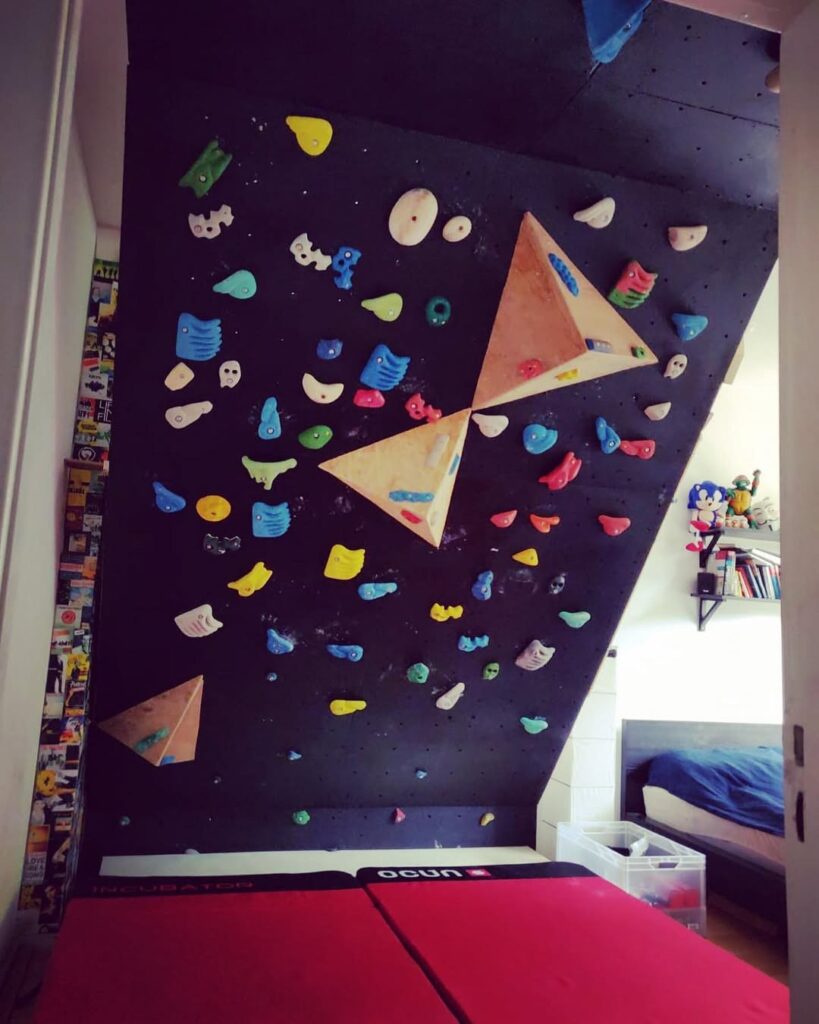
Anyone who wants to train effectively at home will sooner or later come across the... SpraywallA spray wall is an overhanging wall densely packed with holds. Instead of fixed routes, you choose new boulder problems every day. This guide will show you how to plan a spray wall, what angle is best, how many holds you need, and how to distribute them effectively.
- Principle: Many holds in a small area – you define the bouldering problems yourself.
- Angle: A moderate overhang is the best compromise for most.
- Handles: Significantly more than with a normal home wall, with many footholds.
- Mixture: crimps, slopers, crimps and volumes in various sizes.
- Fall protection Coverage across the entire area is mandatory, even at low heights.
What is a spray wall?
The name comes from the fact that the holds appear to be "sprayed" randomly across the wall. That's precisely the trick: the denser the hold pattern, the more boulder problems are created in the same area. You determine which holds count – for example, with photos, markings, or an app. Unlike... System boards Unlike the MoonBoard, which uses a fixed grip pattern and angle, a spray wall can be freely designed.
The correct angle
| inclination | character | For whom? |
|---|---|---|
| vertical to slightly overhanging | Technically, many steps are usable. | Beginners, children, technical training |
| moderate overhang | balanced between strength and technique | most amateur climbers |
| steep overhang | very strenuous, body tension | advanced and strong climbers |
The steeper the wall, the fewer holds are usable for beginners. Those training with family or friends of varying skill levels will find a moderate angle ideal. You can read more about wall angles in [link/reference]. Wall angle when bouldering.

Leave a vertical "kicker" at the bottom of the wall, about the width of a tile. Place small footholds on it – this way you can start low even on a steep wall and train your feet precisely.
Construction and drilling grid
The same basic principles apply to the construction as for any home wall: a load-bearing substructure, plywood panels (Bergzeit magazine recommends at least 21 mm thick), and a dense grid of threaded inserts. For a spray wall, you should choose a denser grid so that you can add holds later as needed. You can find the step-by-step instructions in Build a climbing wall at home, the costs in How much does a climbing wall cost?.
Handle selection and distribution
Small steps and edges make any wall more versatile – plan for them generously.
For finger strength: Afford at multiple depths.
One, two Fibreglass volume create new angles in a small space.
Distribute the holds so that there are no "dead" zones, and rotate holds in different directions: The same crimp can be rotated to a side pull or undercling. Our Climbing hold sets They already bring a balanced mix.
This is how you train at the spray wall
- Hold onto the boulder: Take a picture of your problems or mark them so you can repeat them.
- Limit Boulder: Few, very heavy moves with long pauses for maximum strength.
- Endurance circuit: Long combinations with many easy holds.
- Technology: Only small steps allowed – this is how you learn precise footwork.
In addition, targeted finger training is worthwhile – tips on this can be found in... Finger strength training with climbing holds.
Handles for your spray wall?
We'll put together a suitable grip mix for you – directly from the manufacturer. Or come to our open training wall and test the grips beforehand.
Frequently asked questions about the spraywall
What is a spray wall?
A spray wall is a training wall, usually overhanging, that is densely packed with holds. Instead of fixed routes, climbers choose their own boulder problems, allowing them to climb countless challenges in just a few square meters.
What angle is ideal for a spray wall?
For most climbers, a moderate overhang is a good compromise. The steeper the wall, the more strenuous the training becomes, and the fewer holds are usable for beginners.
How many handles does a spray wall need?
Significantly more than a normal home wall. Bergzeit magazine recommends at least 200 holds for a normal home wall; a spray wall thrives on having holds and footholds available everywhere.
Spraywall or system board
System boards like the MoonBoard use a fixed hold pattern and angle to ensure that boulder problems are comparable worldwide. A spray wall, on the other hand, is freely customizable and can be equipped with your favorite holds.
About the author: Raul Ortiz has been climbing since 2006, develops and casts climbing holds and fibreglass volumes with RX Climbing Holds in Miesbach, and regularly sets boulder and rope routes in climbing gyms in Upper Bavaria. More about us
 English
 German