„How much does a climbing wall cost?“ is the question we hear most often – from families planning a home wall, as well as from clubs and studios. The honest answer: It depends. But not just vaguely. In this article, we'll show you…, What items make up the cost of a climbing or bouldering wall?, which benchmark values you can expect and where you can save money without compromising safety.
- Wood & Material: Bergzeit magazine estimates the cost of a self-built 4 × 4 m wall without holds at around €800–1,000.
- holds are often the largest single item – in sets directly from the manufacturer from about €3–6 per hold.
- Fall protection It is often forgotten, but it is essential for safe bouldering.
- volume This makes a small wall significantly more versatile – a good way to save money.
- Professional walls For clubs, schools and studios, we calculate prices individually based on space and requirements.
Overview of cost items
Every climbing wall consists of the same building blocks. Its cost depends on its size, steepness, and the professionalism of its construction.
| Position | What belongs there | Cost drivers |
|---|---|---|
| substructure | Timber beams, wall anchors, possibly steel | Overhang, height, load-bearing capacity of the space |
| wall panels | Multiplex panels (min. 21 mm according to Bergzeit), edges | Surface area, slab quality |
| T-nuts | approx. 25/m² with a 20 cm grid, approx. 50/m² with a 15 cm grid | Density of the drilling grid |
| Holds & Volume | Holds, footholds, macros, fibreglass volume | Quantity, material (PE/PU/fibreglass), size |
| Fall protection | Soft floor mats or crash pads | Area in front of and next to the wall |
| Assembly & Planning | DIY or professional company | Complexity, testing requirements |
Calculation example: Homewall for the home
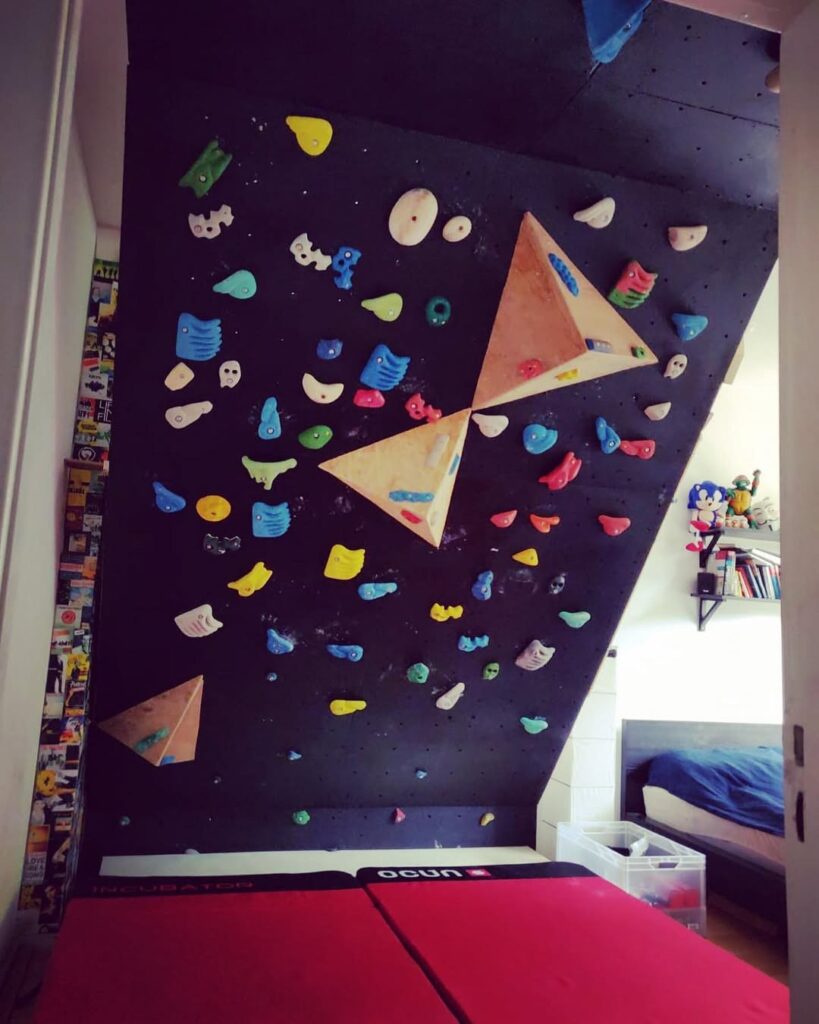
The Bergzeit magazine quantifies the material costs for a self-built wall of 4 x 4 m without climbing holds, costing approximately 800 to 1,000 euros.. For wooden beams, it's recommended to check with a sawmill: there, beams are only about half the price of those in a DIY store. A minimum thickness of 21 mm plywood is specified.
The same guide mentions the holds. at least 200 holds For a home wall, you'll need 250 to 300 holds for a 3 x 4 m wall. This is an expansion stage for ambitious training – half that amount is often enough to start with, especially if you regularly rearrange the holds.
| Example: Homewall approx. 3 × 4 m | guideline |
|---|---|
| Wood, boards, T-nuts (homemade) | comparable to the Bergzeit value of €800–1,000 for 4 × 4 m |
| Start with approximately 120 holds from sets (3–6 €/hold) | approx. €360–720 |
| 2–4 fibreglass volumes | Approximately €60–300, depending on size |
| Mats / Crash pads | Depending on area and quality – don't skimp on this |
The hold prices refer to our own sets: The Diamonds set with 62 holds It's available from €250. Diamonds set with 25 technical holds From €75. fibreglass volumes are available from €30 (The Leaf) up to €99 (Evolution 1).

It's better to place the T-nuts too close together than too far apart. A single T-nut costs little, but every missing one will limit your route-setting for years. Adding them later is only possible if the wall isn't yet mounted.
How much do climbing holds cost – and why do they vary so much?
Hold prices depend on Size, material and manufacturing effort Small crimps and footholds are inexpensive, while large jugs and slopers require more material. Individual PE holds cost from around €4 to €15, while large fibreglass macro holds and bulky sections cost significantly more – but they are lightweight and can completely transform the look of the wall.
Robust and affordable – our standard and the best choice for most walls.
Lighter and particularly break-resistant, slightly more expensive – we can manufacture in PU upon request.
Lightweight and stable, for large structures and macro photography.
Sets are cheaper per hold, individual holds fill specific gaps.
You can find a detailed material comparison in Climbing hold materials compared, and tips for choosing in The right hold set for your home wall.
Where you can save money – and where you can't
Here you can save
- Buy holds as a set instead of expanding individually – and preferably in stages.
- Volume instead of a huge area: Two or three volumes make a small wall as versatile as a larger one.
- Own contribution in woodworking, if you are confident in your craft skills.
- Timber from the sawmill instead of from the hardware store.
You shouldn't skimp here.
- Load-bearing capacity and wall anchors: The fastening must safely absorb the forces.
- Fall protection: Seamless, sufficiently thick mats are the most important form of accident prevention.
- Grip quality: Holds should come from a manufacturer – homemade holds can break.
Climbing wall for club, school, daycare or studio

For climbing walls used in public or commercial settings, additional requirements apply: standards such as DIN EN 12572-2 for bouldering walls, fall protection according to accident insurance specifications, regular inspections, and thorough documentation. We have outlined the requirements for daycare centers and schools in our guide. Climbing wall in the daycare center summarized.
Because space, usage, and requirements vary so much, we don't quote flat rates for such projects, but instead create a customized quote. individual offer. Our advantage: Planning, construction, and holds all come from one source – we cast the holds ourselves in Miesbach, without intermediaries. Learn more on our website. Climbing wall construction.
Do you want to know how much your wall will cost?
Send us measurements, a few photos, and your idea. We usually get back to you within 24 hours with an initial assessment or a quote.
Frequently asked questions about the cost of a climbing wall
How much does a bouldering wall for home use cost?
For a self-built climbing wall of approximately 4 x 4 meters without holds, Bergzeit magazine estimates the cost of wood and materials at around 800 to 1,000 euros. Holds, volumes, and mats are additional costs. Hold sets directly from the manufacturer cost approximately 3 to 6 euros each.
How many climbing holds do I need for my home wall?
Bergzeit magazine recommends at least 200 holds for a home wall and 250 to 300 holds for a 3 x 4 m wall – that's roughly 20 holds per square meter. Significantly fewer will suffice to start with, provided you regularly rearrange the holds and gradually expand your climbing wall.
Which is cheaper: individual holds or sets?
Sets are usually significantly cheaper per grip and offer a balanced mix of grip types and sizes. Individual holds are worthwhile for filling specific gaps or adding particular shapes.
How much does a climbing wall cost for a club, school or studio?
This depends heavily on the area, height, slope, substructure, fall protection, and testing requirements. A reliable estimate can only be given after inspecting the room. We will then prepare a customized quote for you. Inquire here.
All prices are as of October 2026. Material prices for wood vary depending on the region and supplier.
About the author: Raul Ortiz has been climbing since 2006, develops and casts climbing holds and fibreglass volumes with RX Climbing Holds in Miesbach, and regularly sets boulder and rope routes in climbing gyms in Upper Bavaria. More about us
 English
 German