The fingers bear the greatest load when climbing – and that's exactly where most injuries occur. According to Outdoor magazine... Finger injuries The most common injury among climbers is usually... Ring bands This guide explains what annular ligaments are, how injuries occur, and how to reduce the risk.
- Most common injury: According to Outdoor magazine, finger injuries mostly affect the annular ligaments.
- A2 and A4: These two annular ligaments are most commonly affected.
- Main cause: High load on fully extended fingers, sudden force peaks.
- Warning signs: Finger pain after climbing, persistent swelling.
- Prevent: Warm up, increase gradually, and don't pull on small holds when you're tired.
What are ring bands?
The annular ligaments hold the flexor tendons of the fingers to the bone. Lacrux describes them as heavily stressed, passive structures – especially when the fingers are bent. According to the outdoor magazine, the most frequently affected areas are... A2 ring band (area of the metacarpophalangeal joint) and the A4 ring binder (Middle joint area).
How injuries occur
| trigger | Example |
|---|---|
| Maximum load on a fully extended finger | hard pull on a small ledge |
| Sudden bursts of force | Foot slips, dynamic catching of a handle |
| overload | repeated setting up and pulling without sufficient breaks |
| Lack of warm-up | hard pulls on small holds right at the beginning |
According to Lacrux, only about a third of climbing-related finger problems affect the annular ligaments – so finger pain can also have other causes.
Warning signs
- Finger pain after climbing and prolonged swelling after sessions.
- Sudden pain, possibly with an audible „pop“.
- Bowstringing: The tendon visibly lifts when bending – a typical sign of a tear.
If you experience such symptoms: stop and consult a doctor. According to an outdoor magazine, treatment is usually conservative; surgery is primarily necessary in cases of multiple torn annular ligaments.

The most difficult crimp moves belong at the beginning of the session, when your fingers are warm but still fresh – not at the end. If you "just quickly" go for the smallest crimp towards the end, you're straining your fingers precisely when they're most tired.
Here's how to prevent it
- Own warm-up program: First large handles, then smaller ones – see Warming up while bouldering.
- Gradually increase the intensity: According to Lacrux, tendons and ligaments adapt more slowly than muscles.
- Use your open hand: Where possible, use open or half-set grips instead of fully set grips.
- Don't climb when you're tired: Avoid maximum pulls on small holds when tired.
- Cooling down: Light stretching and a small snack after the session.
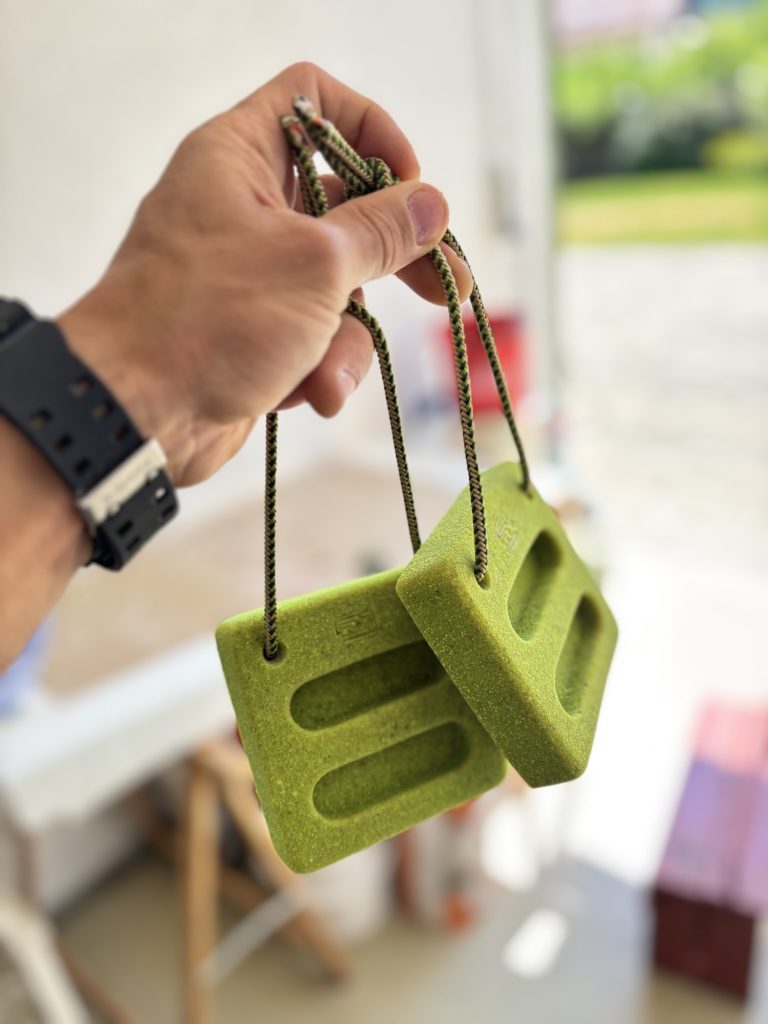
For controlled finger training, training grips with a defined depth are suitable, such as the... Training Grip 10 / 15 / 20 mm or the Finger lift regulators made of PE. More on this in Finger strength training with climbing holds.
Build finger strength safely?
In RX Climbing Holds' personal training sessions, the workload is increased step by step – tailored to the level and goals.
Frequently Asked Questions
What is the most common climbing injury?
According to Outdoor magazine, finger injuries are the most common injury among climbers; the annular ligaments are usually affected.
Which annular ligaments rupture most frequently?
The most frequently affected areas are the A2 ring ligament in the area of the base joint and the A4 ring ligament in the area of the middle joint.
How can I recognize a ring ligament injury?
Typical symptoms include pain, swelling, and sometimes an audible popping sound. A distinct lifting of the tendon (bowstringing) is considered a typical sign of a tear. If such symptoms are present, the finger should be examined by a doctor.
How can I prevent finger injuries?
Thorough warm up, increase the load slowly, avoid fully extended fingers on very small holds at the end of the session, do not continue climbing when fatigued and stop immediately if pain occurs.
Note: This article is not a substitute for medical advice. If you experience pain or injury, please seek medical attention.
About the author: Raul Ortiz has been climbing since 2006, develops and casts climbing holds and fibreglass volumes with RX Climbing Holds in Miesbach, and regularly sets boulder and rope routes in climbing gyms in Upper Bavaria. More about us
 English
 German