Shoes on, chalk on hands, and straight into the project boulder – that's how many start their session. But that's... Warming up while bouldering One of the simplest ways to prevent injuries and improve your climbing. This guide shows how long the warm-up should last, which phases are beneficial, and what comes after the session.
- Duration: According to Bergzeit, 15 to 25 minutes is recommended.
- Three phases: Cardiovascular system, joints, then easy bouldering on large holds.
- Stretch: Stretch briefly beforehand (approx. 8 seconds), then stretch for a longer time afterwards.
- Finger: Increase the load slowly before moving on to the smaller holds.
- Head: Warming up also prepares you mentally for the session.
Why warming up is important
According to Bergzeit magazine, warming up prevents injuries because warmed-up muscles are more supple. This also leads to improved performance, less muscle soreness, and better mental preparation. The outdoor magazine presents a warm-up program developed by trainer Dr. Tyler Nelson, which he claims halves the risk of injury – comparable to warm-up programs used in soccer.
The three phases
- Cardiovascular system: Cycling, skipping rope or jumping jacks with push-ups – the body gets warmed up.
- Joints: Move all joints briefly, from top to bottom or vice versa: fingers, wrists, shoulders, hips, knees, ankles.
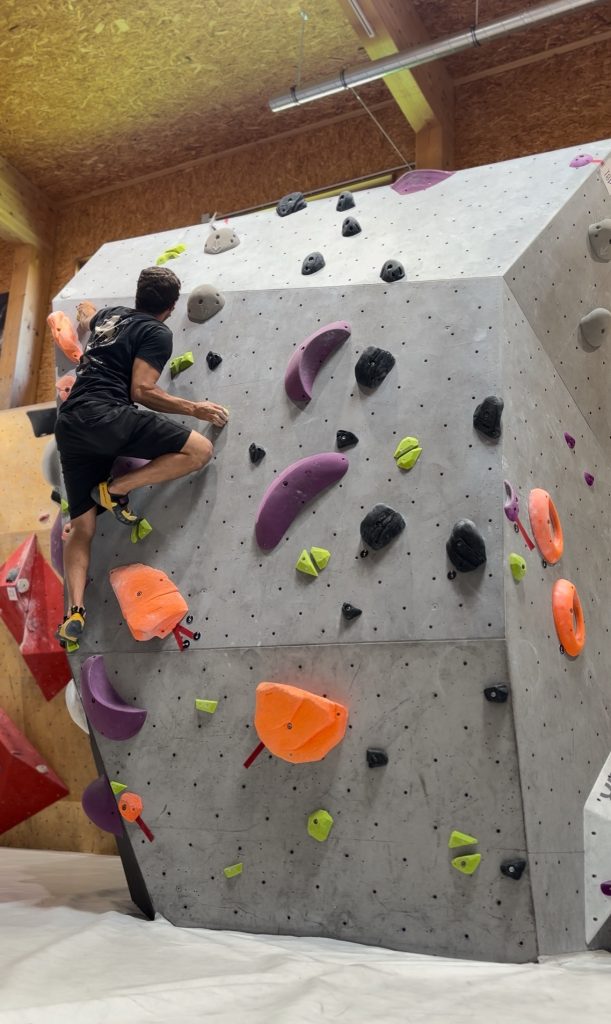
- On the wall: Climb easy boulder problems using large holds and take a break as soon as your forearms get tired.
| phase | Goal | Example according to Bergzeit |
|---|---|---|
| Cardiovascular system | Increase body temperature and pulse | Cycling, rope skipping, jumping jacks |
| joints | Preparing for mobility | Move all joints briefly through their full range of motion. |
| Bouldering wall | Preparing fingers and movements | Easy bouldering problems on large holds |

When warming up on the wall, don't just climb jugs, but gradually incorporate the different holds of the session: first large holds, then slopers and pinches, and finally smaller crimps. This way, your fingers are ready before things get serious.
Stretching: before or after?
According to Bergzeit, only a short [break/break/etc.] is required before bouldering. Stretching for about 8 seconds It makes sense. Longer stretches (over 20 seconds) and passive stretching should be done after the session. Bergzeit suggests using putty or a soft ball for the fingers and a resistance band for the shoulders.
Warming up against the wall
To warm up against the wall, you need Easy bouldering routes on large, durable holds.. Therefore, climbing gyms should always offer enough easy bouldering routes – on their own Training wall A fixed warm-up boulder can be set. Training holds like the [missing information] are also suitable for finger warm-ups. Training Grip. How to keep climbing technique clean is explained in Bouldering technique.
Training with a plan?
In RX Climbing Holds' personal training, warm-up, technique and strength are combined – individually or in small groups.
Frequently Asked Questions
How long should you warm up before bouldering?
According to Bergzeit magazine, 15 to 25 minutes is generally recommended.
Should you stretch before bouldering?
According to Bergzeit, a short stretch of about 8 seconds is recommended. Longer stretches over 20 seconds and passive stretching are better suited for after bouldering.
Why is warming up so important when climbing?
Warmed-up muscles are more supple and less prone to injury. Performance also increases, and the mind prepares for climbing. More on prevention in Preventing finger injuries while climbing.
Is it possible to warm up against your own wall?
Yes. One Training wall This is well suited if some easy boulder problems with large holds are planned.
About the author: Raul Ortiz has been climbing since 2006, develops and casts climbing holds and fibreglass volumes with RX Climbing Holds in Miesbach, and regularly sets boulder and rope routes in climbing gyms in Upper Bavaria. More about us
 English
 German