
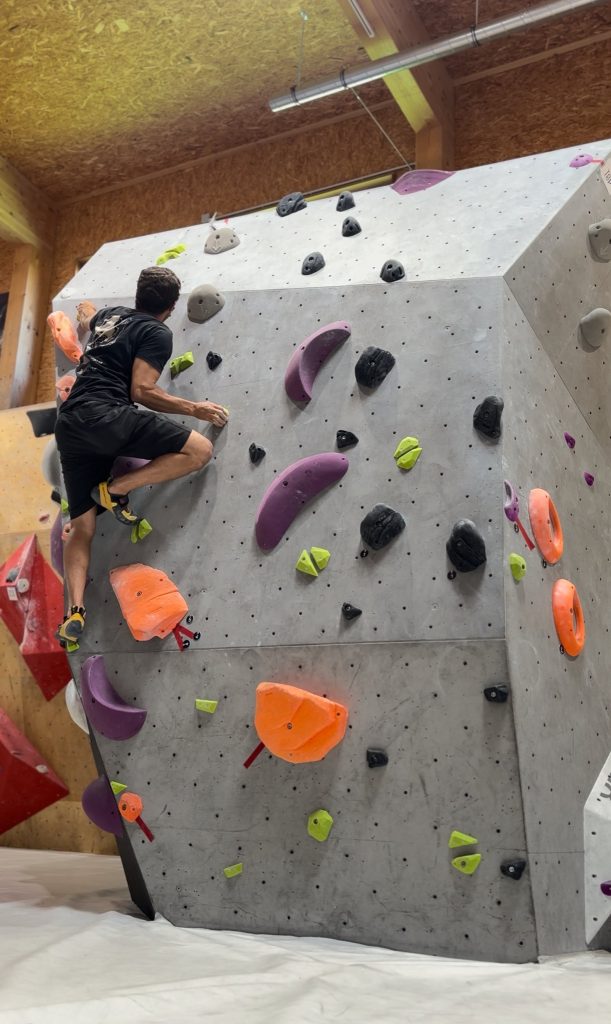
Many beginners try to solve boulder problems using only their arm strength. This works for a while – until their forearms are completely fatigued. Bouldering technique It shifts the workload to the legs and hips, conserves energy, and enables moves that are impossible with pure strength. This guide summarizes the basics: footwork, body position, and the most important moves.
- Feet first: Step precisely with the toe of your shoe, look at the step, and place your foot down quietly.
- Arms long: The reach comes from the legs and hips, not the arms.
- Position instead of blocking: Stability is achieved through correct positioning.
- Six basic moves: Toehook, heelhook, turn-in, mantle, dyno and knee clamp.
- Practice: Technique is learned on easy boulder problems, not at the limit.
Foot technique: the basics
According to Bergzeit, it is usually done with the toe of the shoe Step down – in the area of the big toe. This provides more feel and control. After the initial push-off, it helps to slightly lower the heel: This relaxes the calf and relieves the arms. Small steps save energy compared to high push-offs.
- A look at the feet: Watch the step until your foot is firmly planted.
- Circle the kick: Circle your foot twice around the foothold, then place it down precisely.
- Turn around: Reposition your foot three times before reaching the next handhold.
Body position and arms
The German Alpine Club (DAV) describes a climbing move in three phases: In the Preparation phase The feet are placed precisely. In the Main phase The reach comes from the legs and hips – the arms remain extended. In the Stabilization phase The tension is reduced again; according to the DAV, stability should be achieved through positioning, not through blocking force.
| principle | What it brings |
|---|---|
| arms long | Weight is suspended from the skeleton, the forearms tire more slowly. |
| Shifting the focus | Bring your hips over your feet before the next grip comes. |
| climbing in a twisted position | Hips turned sideways to the wall provide more reach |
| Clean stepping | Less slipping, more confidence in small steps |

During warm-up, consciously climb an easy boulder problem several times – each time with a different focus: once only on quiet footwork, another time only on extending your arms. This way, technique becomes second nature without requiring strength.
The six basic moves
The outdoor magazine lists six basic moves that occur repeatedly in bouldering:
Pulling with the top of the foot keeps the body in the roof position or prevents it from swinging upwards.
Hook your heel in to shift weight or hold an open door.
Turn the leg inwards and tense it between steps – often in the overhang.
Push up over an edge or a rounded exit.
Dynamic pull with momentum from body and legs to a wide grip.
Knees get caught between feet and walls – especially in roofs and chimneys.
The large volume and handles are particularly inviting for hooks and twists – more on this in Climbing volume and macros. How the wall's inclination affects the technology is explained. Wall angle when bouldering.
Exercises for the next session
- Quiet feet: Climbing an easy boulder problem without any footsteps being audible.
- Arms-length round: Initiate each movement from the hips, keeping arms straight.
- One move per session: Practice one of the six basic moves on several boulder problems.
- Video: Film your own attempt and compare it to a smoother attempt.
Targeted improvement of technology?
In personal training sessions at RX Climbing Holds, technique, strength and mental focus are specifically trained – individually or in small groups, in the hall or on the training wall in Miesbach.
Frequently Asked Questions
Which part of the shoe do you use for stepping when bouldering?
Usually with the toe of the shoe in the area of the big toe. According to Bergzeit, this provides more feel and control than pedaling with the midfoot.
Why should you keep your arms long when climbing?
With long arms, the weight is supported by the skeleton rather than the muscles. According to the German Alpine Club (DAV), the reach comes from the legs and hips, while the arms remain extended during the kicking phase.
What is a drop knee?
In drop knee or twisting, the leg is turned inwards to create tension between two footholds – often on an overhang.
What's the fastest way to learn technology?
Through conscious practice of easier boulder problems, targeted foot exercises, and external feedback. A Personal training It reveals flaws that one doesn't notice oneself.
About the author: Raul Ortiz has been climbing since 2006, develops and casts climbing holds and fibreglass volumes with RX Climbing Holds in Miesbach, and regularly sets boulder and rope routes in climbing gyms in Upper Bavaria. More about us
 English
 German