Almost all climbers know the feeling: their legs are shaking, the next move is actually doable – but their head says no. Fear while climbing And bouldering is normal and often beneficial. However, if it's blocking all progress, it's worth working on it specifically. This guide summarizes the recommendations of the German Alpine Club (DAV) and experienced climbers.
- Small steps: Gradually increase height, drop distance, and terrain.
- Practice in realistic conditions: According to the German Alpine Club (DAV), practice falls using real climbing movements.
- Breathing: Conscious, loud exhalation creates distance from the fear.
- Examine your thoughts: Are the worries in your head realistic?
- Patience: Stress makes anxiety stronger – relieving the pressure helps.
Where the fear comes from
Fear is a protective reaction of the body. In climbing, it manifests itself in various forms: as fear of falling while lead climbing, as fear of high moves while bouldering, or as fear of failure. According to an outdoor magazine, for some climbers it only becomes apparent when they are close to their limit or on certain routes, such as overhangs. It's important to recognize the type of fear – because each requires a different strategy.
Fall training in small steps
The DAV relies on two principles: small steps, so gradually increase height, fall distance and terrain, and realistic practice, meaning any fall resulting from a genuine climbing movement.
| Level | Exercise according to DAV |
|---|---|
| Top-rope | Without putting "to" in; later "One move and go" – climb one more move and then fall. |
| lead | „Clip and Drop“ immediately after clipping, followed by fall training at a defined location. |
| Real routes | Red dot falls and "hard flash" – the partner falls first and shows that it is safe. |
According to Bergzeit, fall training on a vertical wall is perfectly sufficient – an overhang is not necessary. The equipment should be checked on the ground beforehand.

The pace during fall training is always determined by the individual falling – not the group. It's better to practice ten small, clean falls than one big one that creates new fear. A bad fall sets you back more than a good one builds you up.
Strategies for the mind
According to Bergzeit, consciously exhaling loudly creates distance from fear.
Observe the "voices in your head" and ask yourself if the concern is realistic.
Focus on your breathing and body instead of thinking about the possible fall.
Address your fear – with your belay partner, the group, or a coach.
Focus on successes instead of just counting setbacks.
Failure is part of the process – most people pay less attention to your degree than you think.
Fear while bouldering
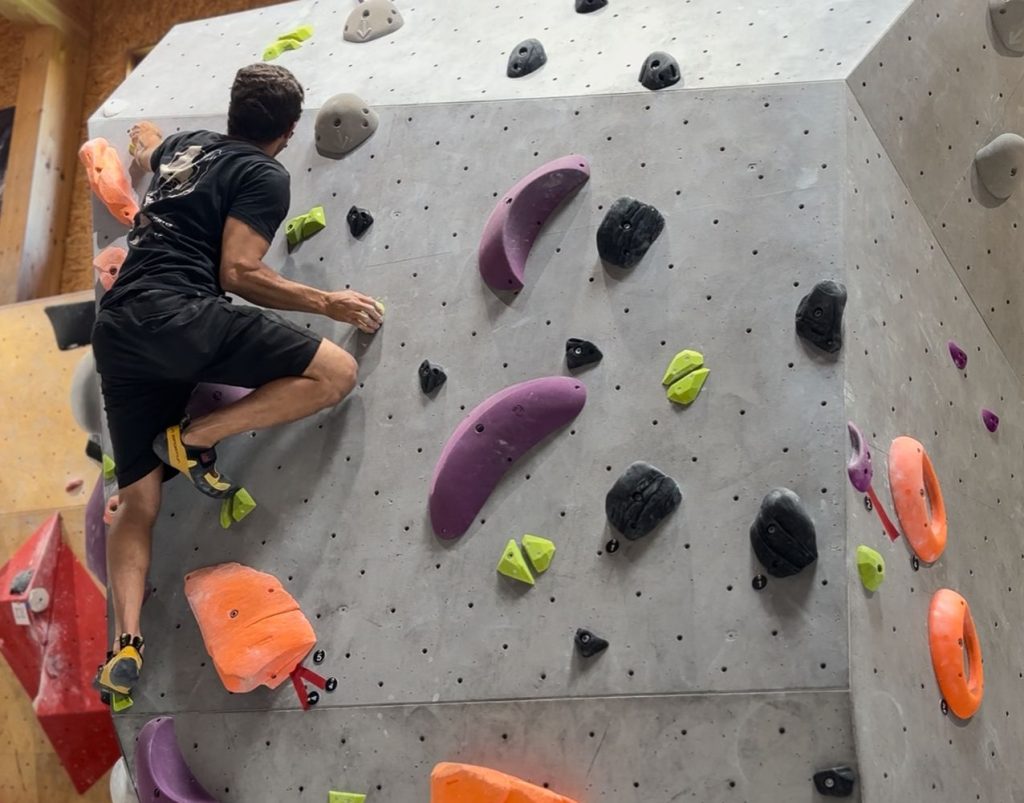
Bouldering is mostly about the fear of high moves and the landing. It helps to... Climbing down To practice consciously and train landing from a low height. On your own wall, moves can be deliberately adjusted so that the height increases gradually – an advantage of... Training wall. Additionally, clean technique helps, because those who stand securely are less afraid: see Bouldering technique.
Don't want to be alone with your fear?
RX Climbing Holds' personal training is not just about technique and strength, but also about fear, blocks and the mind – individually or in small groups.
Frequently Asked Questions
Is fear normal when climbing?
Yes. Fear is a natural protective reaction. The goal is not to get rid of it completely, but to assess it realistically and build trust step by step.
How does a fall training session work?
According to the DAV (German Alpine Club), this should be done in small steps: first on top rope without being belayed too tightly, then on lead climbing with short falls directly after clipping, and only later from real climbing movements.
Does breathing help against anxiety?
According to Bergzeit, consciously exhaling loudly can create distance from fear. A short mantra can also help.
What to do if you're afraid of jumping off while bouldering?
Practice controlled downclimbing, training landings from low heights, and gradually increasing the height. The German Alpine Club (DAV) recommends downclimbing rather than jumping wherever possible – more information can be found in [link/section]. Avoiding injuries while bouldering.
About the author: Raul Ortiz has been climbing since 2006, develops and casts climbing holds and fibreglass volumes with RX Climbing Holds in Miesbach, and regularly sets boulder and rope routes in climbing gyms in Upper Bavaria. More about us
 English
 German