
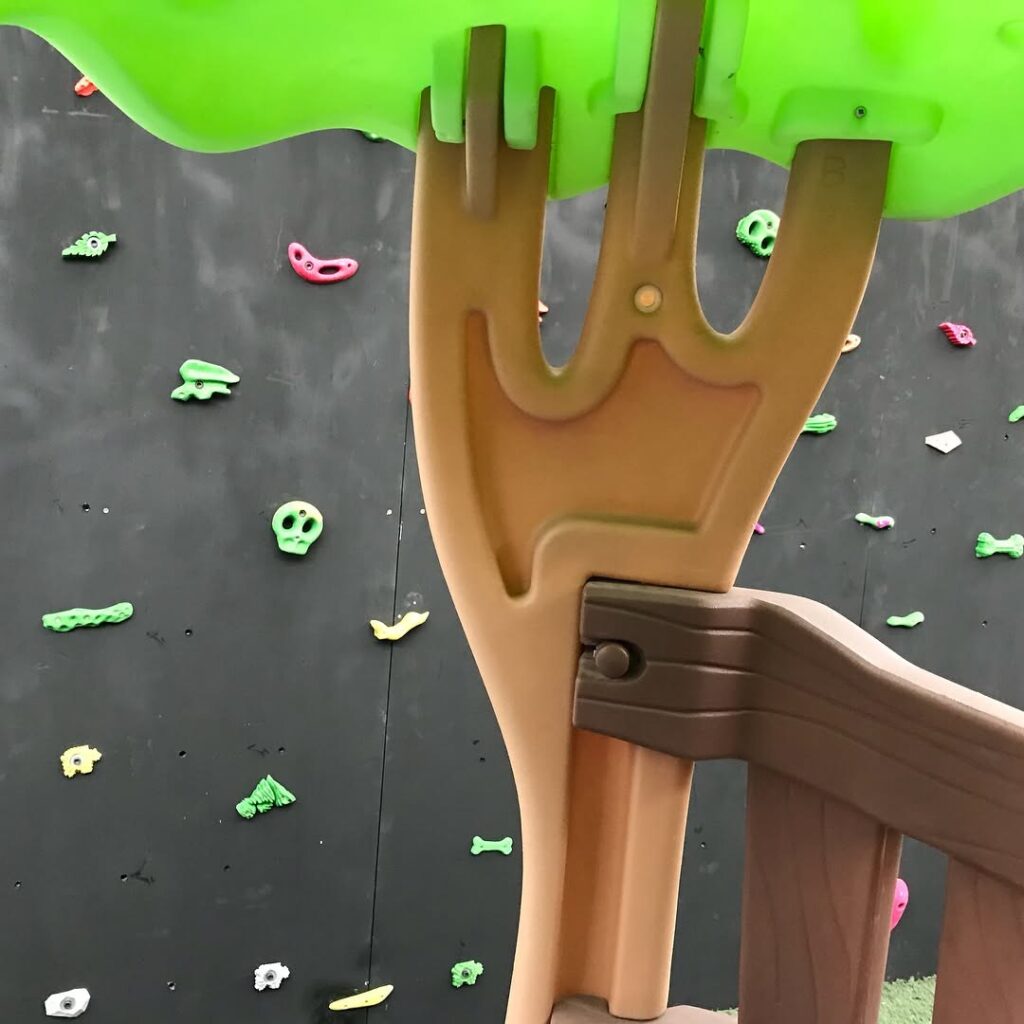
One Climbing wall in the daycare center A climbing wall is one of the best physical activity opportunities a facility can offer: children train strength, coordination, and balance, learn to assess risks, and experience the satisfaction of achieving something through their own efforts. However, to ensure the climbing wall remains enjoyable and meets accident insurance requirements, careful planning is essential. This guide explains what providers, managers, and parent representatives should consider – from the wall's height and fall protection to regular inspections.
- decisive The relevant document is DGUV Information 202-018 „Climbing in daycare centers and schools“ (as of June 2023).
- Free fall height: On bouldering walls, the maximum height is 3.0 m – for kindergarten children, we deliberately plan for a lower height.
- Fall protection From a drop height of 0.6 m over the entire impact area, at least 2 m deep in front of the wall.
- Holds only from specialist companies (DIN EN 12572-3), fastened in secured threaded or flange nuts.
- Exams: Visual inspection before each use, functional test every 1-3 months, main inspection annually.
Why a climbing wall in the daycare center?
Climbing is a fundamental movement that children naturally seek out. On a climbing wall, this becomes a safe and repeatable activity. Every move requires coordinating arms and legs, shifting weight, and planning the next hold. At the same time, climbing is a shared experience: children encourage each other, share solutions, and wait for one another. You can read more about the motor and cognitive benefits in our article. Climbing with children: These are the advantages of bouldering.
Gripping, supporting and kicking strengthen hands, torso and legs – all without a training plan.
A completed section of wall is a visible success that makes children proud.
Children learn to assess their limits and to jump in a controlled manner.
A wall utilizes vertical space and often fits in a gymnasium or hallway niche.
Traverse wall, bouldering wall or climbing landscape?
Three options have proven successful in daycare centers. Which one is suitable depends on the available space, the children's ages, and the budget:
| variant | Typical for | Advantages | Pay attention |
|---|---|---|---|
| traverse wall (climbing across) | Nursery & Kindergarten | Low height, many children at once, easy to supervise. | Clearly mark the maximum foothold height |
| Bouldering wall (also upwards) | Preschool children, after-school care | More challenge, more varied routes | Impact area and mats increase with height |
| Climbing area with volume | Movement rooms, gymnasiums | Slopes and structures make the wall interesting | Tighten the volume securely, no clamping points |
How high can a climbing wall be in a daycare center?
The DGUV Information 202-018 stipulates that for climbing walls in daycare centers and schools, the Do not exceed a free fall height of 3.0 m. This is implemented by ensuring that the top row of footholds is no more than 3.0 m above the impact surface and/or by marking the maximum footfall height on the wall. The regulations do not differentiate between daycare centers and schools.
This is an upper limit, not a target value. For children between three and six years old, we recommend a wall where they primarily climb horizontally and keep their feet significantly lower. This allows the children to jump down independently at any time, keeping the supervisor relaxed. A colored marker or tape indicates to everyone how low their feet are allowed to go.

Plan the wall to be wider than it is tall. A 5-meter-long, low traverse offers more space for children at once than a narrow, high wall – and the children will climb longer because they need to take fewer breaks.
Fall protection and impact area
Fall protection is the most important safety factor – and the point most frequently underestimated in planning. DGUV Information 202-018 specifies the following values:
| Requirement | Value according to DGUV Information 202-018 |
|---|---|
| Fall protection required from | free fall height of more than 0.6 m – then over the entire impact area |
| Impact area in front of the wall | at least 2.0 m (wall height up to 3.0 m), otherwise at least 2.5 m |
| Lateral expansion | at least 50 % of the wall height (up to 3.0 m), otherwise at least 1.5 m |
| Indoor mats | closed surface, flush against each other, secured against slipping |
| outdoor area | Fall height 0.6–1.0 m: shock-absorbing surface; over 1.0 m: fall protection according to DIN EN 1176-1 |
Important: The impact area must be free of obstacles. Radiators, shelves, windowsills, or doors in the impact zone are off-limits. Soft landing mats should only compress slightly to prevent children from twisting their ankles upon landing.
Wall, drilling grid and holds
The DGUV Information provides clear guidelines for the wall surface itself: Holds and footholds are attached using screws in Flange or T-nuts attached, secured from the back. A staggered drilling grid of 20 × 20 cm. Chipboard and softwood panels are unsuitable. No downpipes or windows should be accessible as handholds or footholds in the climbing area.
Regarding the holds: They must from a specialist company (DIN EN 12572-3), DIY construction is not permitted. For children, large, easy-to-grip jugs, rounded shapes, and easily recognizable jugs are suitable – for example, ours. Numbered climbing holds from 0 to 9 or the Kids' holds. Games can be built using numbers, colors and shapes: "Climb from 1 to 5" or "only orange holds".

Examination and supervision in everyday practice
A climbing wall is a piece of play and sports equipment that must be inspected regularly. DGUV Information 202-018 specifies three inspection levels:
- Visual inspection before each use: Are all holds secure, are the mats positioned correctly, and is the fall zone clear? Documentation is recommended.
- Functional test every 1 to 3 months (or according to manufacturer's instructions): Check holds for twisting and cracks, tighten screws – with documentation.
- Main inspection at least once a year by a qualified person, additionally after a risk assessment.
Regarding supervision, the DGUV Information distinguishes between "bouldering under control" (close physical contact and readily available for intervention) and "bouldering under supervision" (visual contact and verbal guidance). The specific form that applies and the maximum group size are determined by the facility in its regulations. Risk assessment It is confirmed. In Bavaria, the Bavarian Municipal Accident Insurance Association (KUVB) is the contact point for questions regarding accident insurance.
This is how a daycare project with us works
- Initial consultation: You send us photos and measurements of the room and tell us how old the children are.
- Concept & Offer: We suggest wall size, height, hold selection and fall protection – to suit the room and budget.
- Construction & Assembly: We are building the wall and installing the first routes with holds from our own production in Miesbach.
- Handover: We show the team how to check and adjust holds so that the wall remains exciting for a long time.
Are you planning a climbing wall for your daycare center?
Send us photos and dimensions of the room – we'll usually get back to you within 24 hours with an initial assessment. You can find more examples on our children's climbing walls page.
Frequently asked questions about the climbing wall in the daycare center
From what age can children climb on a kindergarten climbing wall?
Even children of nursery and kindergarten age can climb on a low bouldering or traverse wall, provided the height, holds, and fall protection are appropriate for their age group and a qualified professional is supervising them. The required level of supervision is determined by the facility in its risk assessment.
How high can a climbing wall be in a daycare center?
According to DGUV Information 202-018, the free fall height on climbing walls in daycare centers and schools should not exceed 3.0 m. In practice, we usually plan for significantly lower heights for small children and clearly mark the maximum foothold height on the wall.
What kind of mats are needed under a children's climbing wall?
For free fall heights exceeding 0.6 m, fall protection is required across the entire impact area. Indoors, mats with a closed surface are suitable; these must lie flush against each other and be secured against slipping. For walls up to 3 m high, the impact area extends at least 2 m in front of the wall.
How often does a climbing wall in a daycare center need to be inspected?
DGUV Information 202-018 specifies a visual inspection before each use, a documented functional test every 1 to 3 months and a main inspection by a competent person at least once a year.
Are educators allowed to change holds themselves?
Yes. Qualified personnel are permitted to install, relocate, or replace handholds and footholds themselves using appropriate tools. However, the handholds must be supplied by a specialist company; homemade handholds are not permitted. We will gladly demonstrate the procedure to the team during the handover.
Note: This article summarizes the most important points and does not replace a risk assessment. The current regulations of your accident insurance and the mentioned standards are binding.
About the author: Raul Ortiz has been climbing since 2006, develops and casts climbing holds and fibreglass volumes with RX Climbing Holds in Miesbach, and regularly sets boulder and rope routes in climbing gyms in Upper Bavaria. More about us
 English
 German