
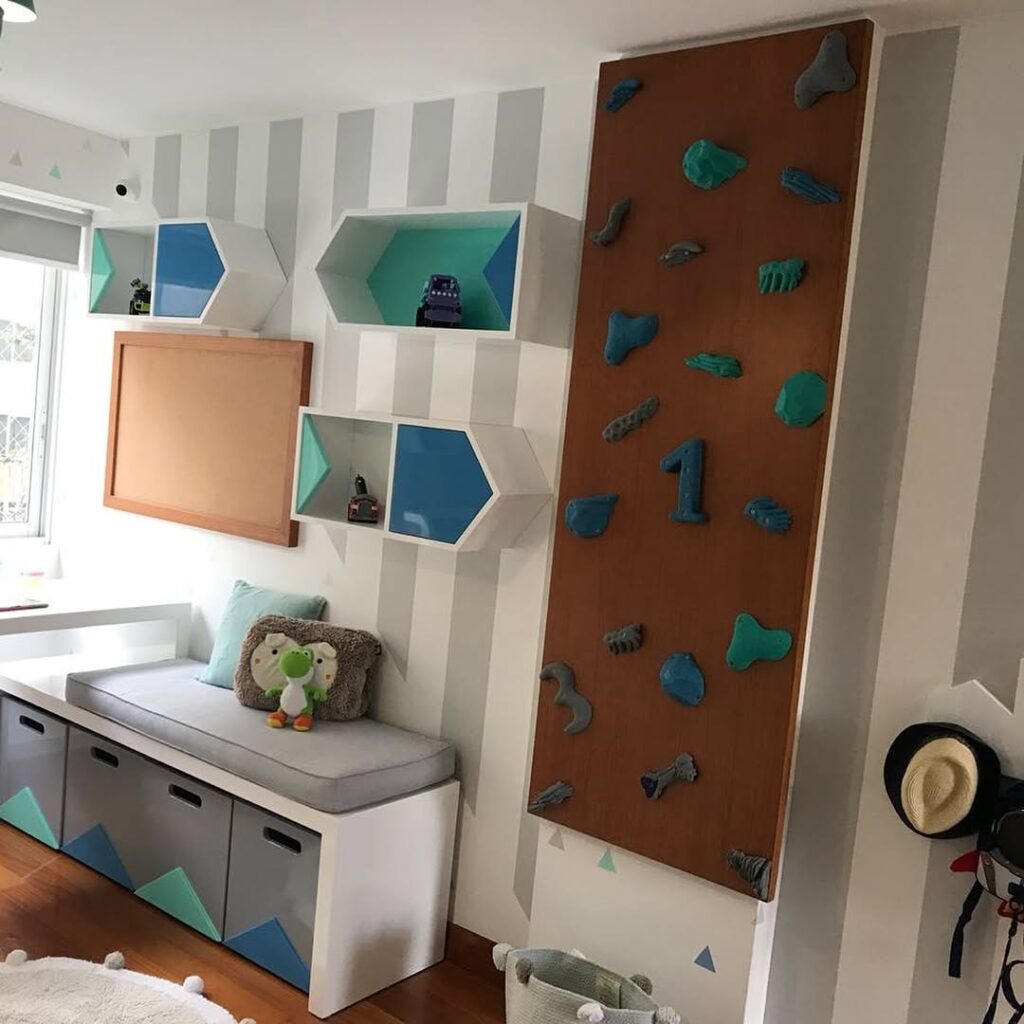
Children climb on everything they can find – sofa backs, shelves, and door frames. Climbing wall in the children's room It channels this urge to move in a safe direction and quickly becomes a favorite spot. In this guide, we'll show you how to plan a children's climbing wall at home, which wall is suitable, how high it should be, and which holds are right for little hands.
- First check the wall: The climbing wall must be attached to a load-bearing wall or substructure.
- Wooden board with threaded inserts Instead of embedding handles directly in the plaster – this way the handles remain movable.
- Better wide than tall: A crossbar is safer and more varied for children.
- Fall protection: Mat covering the entire surface in front of the wall, non-slip and without gaps.
- Child-friendly handles: large, round shapes, bold colors, numbers or motifs for playing.
Planning: Wall, space and substrate
Before you choose handles, you need to clarify three questions: Can the wall support weight? Is there enough space in front of it? What lies within the fall zone? Solid walls made of concrete or brick are ideal. For drywall or timber-framed walls, you'll need a substructure that's screwed into the load-bearing elements. If in doubt, seek advice from a specialist company – a climbing wall not only supports the weight of a child but also the dynamic forces involved in pulling and jumping.
In front of the wall, you need a clear area without furniture, radiators, or toy boxes. As a guideline, you can refer to the regulations for daycare centers: there, the impact area must extend at least 2 meters in front of the wall for walls up to 3 meters high.
Construction: Plate, T-nuts and drill grid
The proven solution is a Multiplex wood panel with T-nuts (M10), which is mounted on wooden beams at a distance from the wall. You screw the holds into the threaded inserts using Allen screws. Advantage: You can reposition holds at any time and create new routes without damaging the wall.
| component | Recommendation |
|---|---|
| plate | Multiplex/plywood of climbing wall quality; chipboard is unsuitable. |
| Drilling grid | staggered, approx. 20 × 20 cm (this is also recommended by the DGUV for daycare centers and schools) |
| Attaching the handles | M10 T-nuts inserted from the rear, handles with matching Allen screw |
| Distance to the wall | Wooden beams to provide space for the T-nuts |
| Edge | Round off or cover all edges, no sharp corners |
We show you in detail how to build a wall step by step in Build a climbing wall at home and in the instructions Mount climbing holds correctly.
What height is appropriate?
For daycare centers and schools, DGUV Information 202-018 stipulates that the maximum free fall height on bouldering walls should be 3.0 m. We recommend significantly less for children's bedrooms: A wall where children primarily climb horizontally and their feet are not much higher than about an adult's knee height is ideal for young children. As they get older, you can add more holds higher up.

Use colored tape to mark a "foot line" on the wall. Only hands are allowed to touch above it. Children accept this rule surprisingly well – and you don't have to constantly shout "not so high!".
The right handles for children
Children's hands are small, their strength is limited. That's why... large handles and round, easy-to-grip shapes Ideal. Sharp edges or very small ledges don't belong on a child's wall. Bold colors help to identify routes, and motifs turn the wall into a playground.
Our Numbered climbing holds 0–9 They invite you to count and calculate on the wall.
Handles like The Torch or The Leaf Mask are easy to hold.
A few smaller holds as footholds train precise footwork.
Robust polyester (PE) as standard, lighter, break-resistant PU handles available on request.
You can find all children's handles in our category Kids' holds and at the Children's handle sets.
Game ideas for the climbing wall
- Color routes: „"Yellow holds only today!" – simple rules turn the same wall into a new game every day.
- Number hunt: Climb in sequence using numbered grips from 1 to 9, or solve math problems.
- Stuffed animal rescue: A stuffed animal is hanging at the end of the truss and needs to be "rescued".
- Freeze: When the music stops, everyone must remain still against the wall for three seconds.
Home safety checklist
- The wall or substructure provides secure support; fastening is made to load-bearing parts.
- The handles are from a manufacturer, not homemade.
- All screws are tight – check regularly and tighten as needed.
- The mat covers the entire area in front of the wall, lies non-slip and without gaps.
- No furniture, radiators or edges in the fall area.
- Small children only climb when an adult is nearby.
Do you want a climbing wall for the children's room?
We design and build children's climbing walls and deliver our holds throughout the EU. Send us a photo of the wall and the dimensions – we'll advise you personally.
Frequently asked questions about climbing walls in children's rooms
At what age is a climbing wall a good idea in a child's room?
Many children love to climb as soon as they can walk and grip confidently. For toddlers, a very low wall with large holds is sufficient. The crucial thing is that the wall can grow with the child: holds can be easily adjusted and replaced with smaller ones at any time.
Can I screw climbing holds directly into the wall?
We advise against this. A better option is a wooden plate with threaded inserts, securely attached to a load-bearing wall. This way, you can easily reposition handles with M10 screws at any time without drilling new holes in the wall.
How many holds do I need for a children's climbing wall?
For a small children's bedroom wall, 20 to 40 holds are often sufficient. More important than the quantity is the mix: many large, easy-to-grip holds and some smaller footholds, so that children learn to consciously place their feet.
What kind of mat do I need under my climbing wall at home?
A thick, non-slip soft floor mat or crash pad that covers the entire area in front of the wall and extends slightly over the sides. For daycare centers and schools, the German Social Accident Insurance (DGUV) requires fall protection starting at a fall height of 0.6 m – this is also a good guideline for home use.
About the author: Raul Ortiz has been climbing since 2006, develops and casts climbing holds and fibreglass volumes with RX Climbing Holds in Miesbach, and regularly sets boulder and rope routes in climbing gyms in Upper Bavaria. More about us
 English
 German